Customer Success Programs
Explore our business growth programs, made to help you grow faster.
HighLevel gives agencies one system to run their clients' businesses — CRM, messaging, funnels, calendars, and automation, with every client in its own sub-account. When the company decided AI would sit across all of it, the decision was bigger than a feature. An agent that answers customers on chat, SMS, social, and the phone is not a tool inside the product. It is the product, speaking.
That is an infrastructure problem before it is an AI problem. HoopAI Technology Services was brought in to help design the foundation: one place for a business to put what it knows, one way for every agent to reach it, and a repeatable method for proving an answer is right before it ships.
Make AI answers something the platform provides, not something every agency has to assemble for itself.
Two million businesses is a lot of different questions. A roofing company, a medspa, and a law firm ask nothing alike, and the agency in the middle carries the reputation for whatever the agent says. So the target was never a clever bot. It was a layer underneath every bot: dependable, inspectable, and the same for everyone.
We did not start with a deck. We started with the product.
HoopAI ran HighLevel the way an agency runs it — real sub-accounts, real content sources, real conversations across chat, SMS, social, and voice. Every observation was written up the same way: what we asked, what came back, what should have come back, which source it should have drawn on, and the steps to reproduce it. A reproduction is worth more than an opinion, and unlike an opinion it survives the trip to an engineering team.
Then we took those findings to the people who owned each surface. That part took longer than the testing did, and it mattered more.
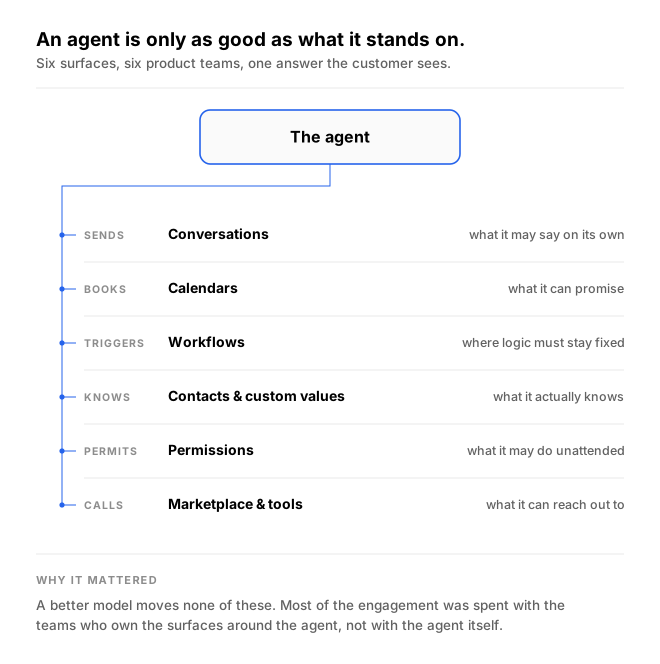
An AI answer is only as good as the systems around it. If the calendar cannot say what is free, the agent cannot book. If custom values are thin, the agent has nothing to quote from. If permissions are unclear, nobody trusts it with an action in the first place.
So the conversations went well past the AI roadmap. Across the engagement we worked with more than forty product managers and leads from every part of the platform. Each of them owned a piece the agent had to stand on.
The central recommendation was to stop treating knowledge as bot configuration and start treating it as infrastructure.
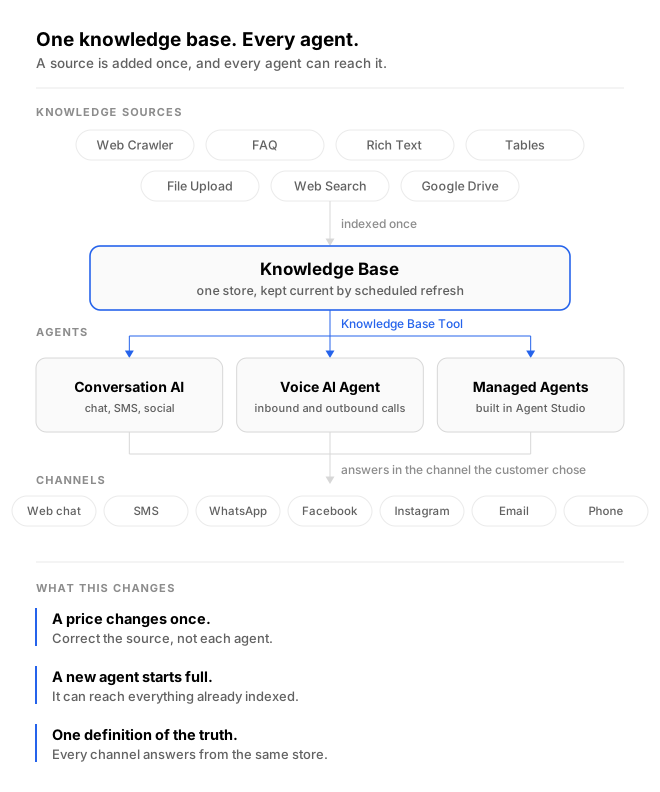
That means one place where a business puts what it knows — crawled pages, rich text, structured tables, question sets, uploaded files, live web results, and connected document drives — and every agent reads from it. A price changes once. A policy is corrected once. A new agent can reach everything already indexed instead of starting at an empty crawler.
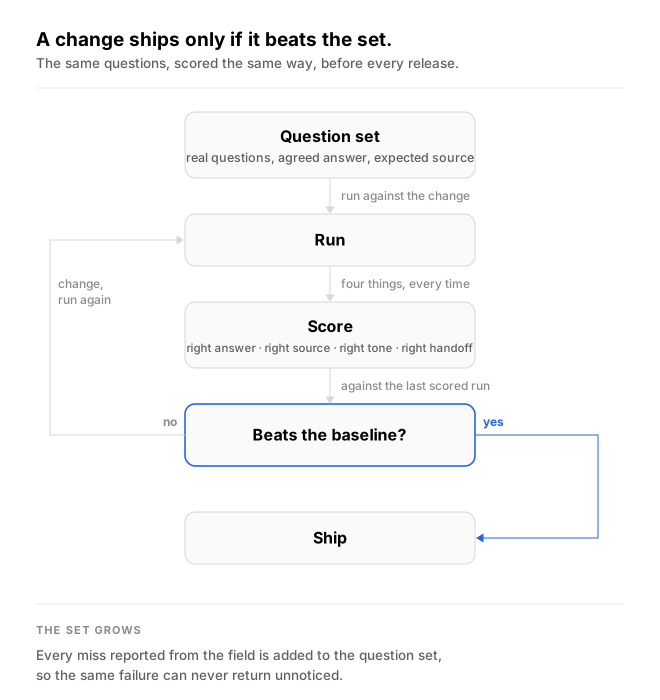
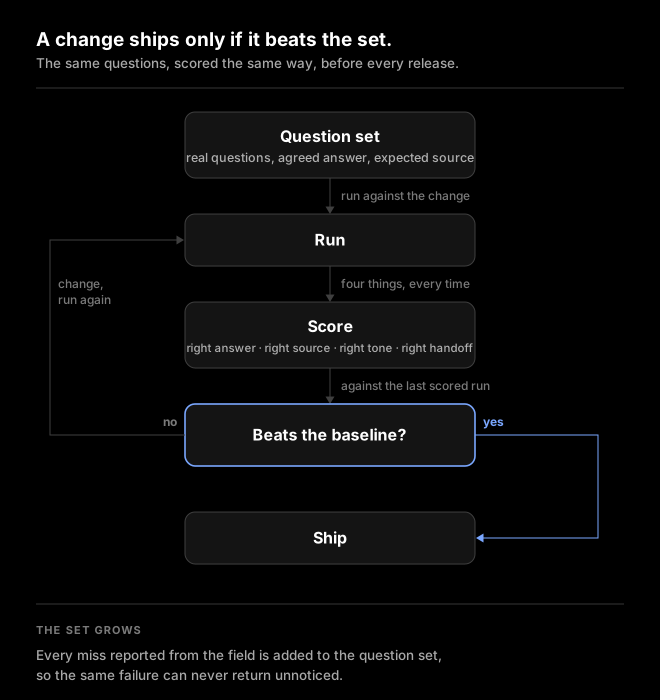
A better retrieval setting is only worth having if you can show it is better. The gap we kept returning to was not a missing feature; it was a missing method. So we built one with them.
Fixed sets of real customer questions per industry, each with an agreed correct answer and the source it should come from. Run the set. Score the answers. Keep the set. When a prompt, a model, or a retrieval setting changes, run it again and compare. A change that cannot beat the set does not ship.
The real measure of infrastructure is what gets built on top of it afterwards. HighLevel's AI surface expanded quickly once the knowledge layer and the evaluation habit were in place: a visual builder for multi-agent systems, agents that call tools and external connectors, document drives as a knowledge source, conversation memory, and permissions that decide who can view or change an agent.
None of those are HoopAI features. All of them need the same two things underneath — one dependable place for an agent to look something up, and a way to tell whether the answer was good. That is the part we worked on.
Agencies rarely leave a platform because a feature is missing. They stay when they can trust it in front of their own clients. An agent that answers well is not a support ticket avoided; it is an agency looking good to the business paying them.
Once answers were consistent and an agency could see which source an answer came from, AI stopped being a risk to manage and became a reason to stay. Churn tied to AI quality fell by 26% by the second month of the engagement.
Most AI projects fail in the same place, and it is almost never the model. It is the ground underneath it: knowledge scattered across tools, no shared definition of a right answer, and no way to prove that today's change is an improvement.
HoopAI Technology Services takes one AI job and makes it work in real life — the data it reads, the rules it follows, the tests it has to pass, and the point where a person takes over. Then we hand it back with the method, so your team can keep it working without us.